
FUZZFACED
  • Home
  • Home
  • Stratocaster
  • Stratocaster
  • Telecaster
  • Telecaster
  • Les Paul
  • Les Paul
  • Marshall & Celestion
  • Marshall & Celestion
  • Pedals
  • Pedali
  • my gear
  • my gear
  • Stories
  • Aneddoti
  • Blog
  • Blog
<<< PreVIOUS
HISTORY OF THE Stratocaster
Next >>>

American Elite Series

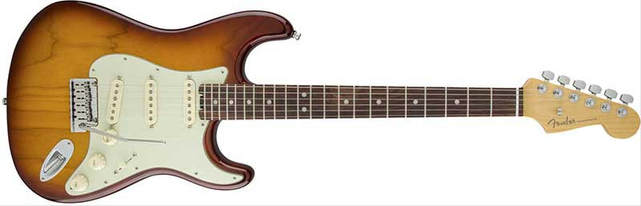
American Elite Stratocaster
Italian
English
The Fender American Elite Series on display at the Fender booth during the 2016 NAMM Show
The American Elite Series was unveiled at the Winter NAMM Show in 2016, replacing the celebrated American Deluxe line as Fender’s new high-end range of U.S.-made guitars.
According to Richard McDonald, Fender’s Executive Vice President and Senior Vice President of Marketing, the development of the American Elite instruments took over two years of dedicated research and design.
“The American Elite Series is our most progressive and advanced series of electric guitars to date,” McDonald stated. “We spent two years refining every detail to give modern players the tools they need to excel and write the future of music.”
At launch, it was priced at $1,799 for most finishes, with a few models listed at $1,899—significantly higher than the American Standard Stratocasters of the time. Each guitar came in a sleek ABS Elite Molded Case equipped with TSA-approved locks.
But aside from the name, new finishes, and the case, what changed between the American Deluxe Stratocaster and the new American Elite Stratocaster?​

4th Generation Noiseless Pickups and the HSS model

When Fender launched the 4th Generation Noiseless pickups (also known as Gen‑4 or N4) with the American Elite Series in 2016, it marked the culmination of years of refinement.
Justin Norvell, at the time Fender’s Senior Vice President of Product Development, explained that instead of building directly on the voicing of the previous three generations of Noiseless pickups, the R&D team started fresh. They used Fender’s American Vintage ’65 single-coil as a tonal reference, aiming to create a more classic sound. However, according to many guitarists, the Gen‑4 pickups still fell short of delivering a truly vintage tone.
“The 4th Generation pickups are an entirely new design. We spent two years in development and produced dozens of versions to get it right. There’s a bit of a secret to the formula, but we used separate pole magnet sets in the coils and then experimented with different wire gauges between the coils and different Gauss strengths in the magnets until we achieved the optimal combination. They’re all-new; new bobbins, magnets, everything. […] We also made sure to voice them to be musical and smooth with high gain.”

Justin Norvell

At the heart of each pickup was a stacked dual-coil design. But what truly set the Gen‑4 Noiseless pickups apart was their custom-staggered AlNiCo 5 magnets.
4th Generation Noiseless Stacked Coil
Unlike vintage-style pickups—originally voiced for heavy wound third strings and rounder fingerboard radii—these magnets were carefully staggered: not completely flat, but also not excessively raised or lowered. This mild stagger helped maintain an even string response across all six strings, avoiding the uneven output often caused by more extreme pole piece heights. The design worked particularly well with modern string sets and fingerboards in the 9.5” to 12” radius range.
To further reduce the noise floor, Fender also used shielded wire inside the pickup.
Fender’s 4th Generation Noiseless pickups were visually identifiable by a cursive Fender logo and the word “NOISELESS” in silver, uppercase block letters on the pickup cover. On the underside, each pickup was marked with “N4 MVT.”
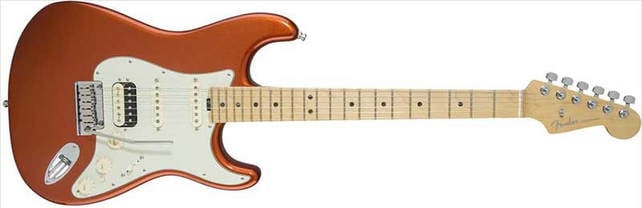
In addition to the SSS version, Fender also released the American Elite Stratocaster HSS Shawbucker, which featured a Shawbucker humbucker in the bridge position (described in detail here).
4th Generation Noiseless Top
4th Generation Noiseless Bottom

Electronics

The American Elite Stratocaster featured the unobtrusive S-1 Switch, which allowed players to access a wider range of tonal options at the push of a recessed button located on top of the volume knob. This switch allowed players to combine all three pickups simultaneously and access standard pickup combinations wired in series rather than the typical parallel configuration.
Its Tone 2 control, which affected the bridge and middle pickups, was designed as a No-Load tone control. When turned all the way up, the tone circuit was completely bypassed—removing the 250k potentiometer from the signal path to increase output and enhance clarity.
American Elite Soft Knobs and Switch S-1
The HSS Stratocaster model also included a Passing Lane button, positioned between the two tone knobs. This button allowed a direct bypass to the bridge pickup, regardless of the other selector settings, delivering the purest possible signal by circumventing all tone and volume controls.

The neck and the Fretboard

One of the standout features of the Fender American Elite series was its satin-finished neck, which boasted a 9.5”–14” compound-radius fingerboard and flowed seamlessly into a smooth, asymmetrical heel designed for enhanced playing comfort.
What truly set the neck apart, however, was its compound profile—starting with a modern “C” shape at the nut and gradually transitioning to a modern “D” shape at the body joint. This was a completely new design innovation for Fender. The company invested significant time and effort into developing it, with the R&D team testing over a dozen different profile shapes before settling on the final design for the American Elite Series.
​Additionally, the American Elite Stratocaster featured a genuine bone nut, an upgrade over the synthetic bone nut used in the previous American Deluxe line. Real bone, being harder, offered better tonal transfer and contributed to improved sustain and tuning stability.
American Elite Stratocaster Neck Profile
The American Elite series was initially offered with both maple and rosewood fingerboards. However, in mid-2017, rosewood was replaced by “streaked” ebony due to CITES regulations restricting the import and export of rosewood in the United States.
American Elite Streaked Ebony fretboard
The ebony used on the American Elite guitars and basses was not the typical uniform black seen on some ebony fingerboards. Instead, the streaks running through these ebony fingerboards were entirely natural, as the wood was sustainably harvested in West Africa.
Ebony trees grow with varying degrees of color, and only about one in every ten ebony trees produces uniformly black wood. The rest, featuring multi-colored streaks, would typically be left behind in the forest—wasted.
“Most people perceive ebony as a black wood, but it actually can have lighter streaks in it. Loggers would leave ebony with lighter streaks sitting on the forest floor because they were looking for darker wood. These fingerboards are all-natural and high quality. It’s really an upgrade, a premium tonewood.”
​

Joey Brasler,
VP of Fender and Squier Electric Guitars and Basses Product Development
Brasler also noted that tonally, ebony sits somewhere between maple and rosewood, offering a pleasing brightness that complements the fourth-generation Noiseless pickups featured in the American Elite Series.
 
An important improvement was the all-new neck heel. Thanks to its refined design, the corner closest to the fingerboard was rounded off to provide easier access to the upper frets on the guitar.
American Deluxe Stratocaster Neck Heel
American Elite Stratocaster Neck Heel

Hardware

The new double-action truss rod eliminated the Micro-Tilt adjustment but introduced a new wheel-style mechanism—allowing neck relief adjustments without removing the strings or the neck. This was a first for a Fender in this series.
The American Elite Stratocaster featured a two-point Deluxe Synchronized Tremolo bridge, which included a high-mass, copper-infused block, a pop-in tremolo arm, and polished chrome block saddles, replacing the bent steel saddles used on the American Standard bridge.
American Elite Wheel Truss Rod Adjustment
The gloss-finished headstocks sported a silvery “Spaghetti” foil logo and a redesigned string tree Fender called the ‘New Modern “T.”' They also came equipped with short-post locking tuning machines, which improved the break angle over the nut.
American Elite Stratocaster Headstock
All Strat controls were topped with soft-touch knobs—so named for the strip of soft rubber around their cylindrical section, providing extra grip for even the smallest adjustments.
The Fender strap locks included with the American Elite Series were not fully compatible with Schaller strap locks, as the part installed into the body of the American Elite Stratocaster was a few millimeters taller than the Schaller counterpart.

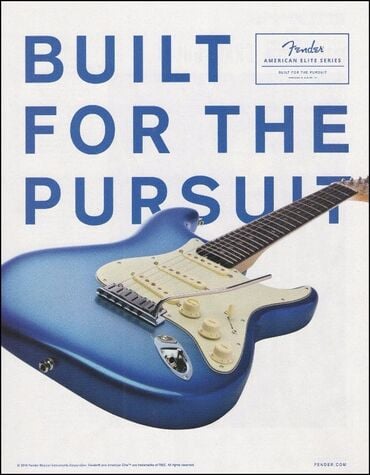
Built for the Pursuit

The “Built for the Pursuit” campaign for Fender’s American Elite Series in 2016 was conceptualized and executed by Hint Creative, a Salt Lake City-based branding and design agency.
The campaign, which featured artists such as John 5, Mikaiah Lei (The Bots), Dave Nassie (Bleeding Through), Jim Fairchild (Modest Mouse), and Ryan Merchant (Capital Cities), marked a significant moment in Fender’s modern history. For decades, the brand had leaned on its vintage legacy — the golden era of the ‘50s and ‘60s, the legends who played Stratocasters and Jazz Basses into the cultural canon. But in 2016, Fender looked forward.
Through cinematic video spots, player testimonials, and immersive online content, the campaign focused on one thing: the relentless journey of the modern musician. It celebrated not just those who had “made it,” but those who were still chasing their sound—pushing themselves night after night, gig after gig. The message was clear: Fender builds instruments for the restless, the driven, the ones who never settle.
The campaign didn’t just highlight new specs; it honored the musician’s mindset. The long nights. The search for perfect tone. The hunger to evolve. That’s what the “pursuit” was really about—and that’s what Fender claimed to support.
Looking back, Built for the Pursuit was more than just a product launch. It was a reminder that Fender, even in the age of digital everything, still understood the soul of the player. 
Built for the Pursuit Campaign, John 5
Built for the Pursuit Campaign, Sky Burst Metallic Strat

​Antonio Calvosa
Contatti e Mailing List
La pubblicità su Fuzzfaced
Privacy Policy 
Tab Store
Paypal

Copyzero
© COPYRIGHT 2014-2024 FUZZFACED.NET BY ANTONIO CALVOSA - TUTTI I DIRITTI RISERVATI
​La copia, la riproduzione, la pubblicazione e la redistribuzione dei contenuti, se non autorizzate espressamente dall'autore, sono vietate in qualsiasi modo o forma. 

DICHIARAZIONE
Le parole Fender®, Telecaster®, Stratocaster® e i design delle palette sono marchi registrati di Fender Musical Instruments Corporation.

Contacts and Mailing List
Advertising on Fuzzfaced
Privacy Policy
Tab Store
PayPal

Copyzero
© COPYRIGHT 2014-2024 FUZZFACED.NET BY ANTONIO CALVOSA - ALL RIGHTS RESERVED
The copying, reproduction, publication and redistribution of the contents, unless expressly authorized by the author, are prohibited in any way or form.

DISCLOSURE
The words Fender®, Telecaster®, Stratocaster® and the associated headstock designs are registered trademarks of the Fender Musical Instruments Corporation.
  • Home
  • Home
  • Stratocaster
  • Stratocaster
  • Telecaster
  • Telecaster
  • Les Paul
  • Les Paul
  • Marshall & Celestion
  • Marshall & Celestion
  • Pedals
  • Pedali
  • my gear
  • my gear
  • Stories
  • Aneddoti
  • Blog
  • Blog