FUZZFACED
  • Home
  • Home
  • Stratocaster
  • Stratocaster
  • Telecaster
  • Telecaster
  • Les Paul
  • Les Paul
  • Marshall & Celestion
  • Marshall & Celestion
  • Pedals
  • Pedali
  • my gear
  • my gear
  • Stories
  • Aneddoti
  • Blog
  • Blog
History of the Stratocaster
NEXT >>>

Lace Sensor pickups

Fender Lace Sensor
Italian
English

Lace Sensor History

The Lace Sensor pickups represented a significant innovation in guitar technology when they were introduced in the mid-1980s. Designed to eliminate the typical hum and noise associated with single-coil pickups, they achieved this without compromising the bright, clear tone that players loved.
Lace Sensor pickups were developed by Don Lace Sr. and marketed by Actodyne General Inc. (AGI), the company he founded in 1979 as a manufacturer of solenoids for the semiconductor industry, with coil winding at the heart of the business.
At first, Don and his two sons, Don Jr. and Jeff, started the business out of their family garage in Huntington Beach, Orange County.
Don Lace Sr. had an extensive background in high-intensity lighting, speakers, and magnetics. This included linear motors, solenoids, alarms, radios, and other highly complex magnetic devices.
A young Don Lace
A young Don Lace
His expertise in speaker design brought him to Fender Musical Instruments in 1967. There he consulted on speakers and various issues regarding pickup manufacturing. Through his work with Fender, Don was introduced to the fascinating world of the music industry.
While looking for additional business opportunities, Lace found that Fender had a high rejection rate during the production of traditional-style pick-ups that were made at the time. Eager to become more involved in the music industry, Lace began developing a new pickup with a lower rejection rate during production. 
​
Don Lace hand drawing
Lace used one of his existing solenoid patents that was part transducer as well as “open and closed” device called a shock generator. The first pickup, designed in 1982, utilized metal barriers surrounding the coil, similar to the metal claws on Fender Jaguar pickups, to minimize hum and focus the magnetic field beneath the strings.
​Lace applied the new pickup to an old beat-up Sears guitar he bought at a garage sale. He plucked the string and it worked. Lace’s design resulted in a punchier top and bottom end, increased tonal harmonics, and decreased electromagnetic interference.
​By the mid-1980s, Don Lace had perfected a single rectangular-shaped pickup—or sensor, as he preferred to call it because it sensed the string’s vibrations. The first pickups he developed were the S-100 and the S-150. They had an “AGI” logo positioned on the left side of the pickup cover and a “Don Lace” logo positioned on the bottom right-hand corner of the pickup cover.
Don had a letter of intent signed with Kramer Guitars but they were a little too busy to follow through on it. So, he and his sons took a step back and regrouped to see where we really wanted to go.
At that time, a group of Fender employees had just purchased the company from CBS. “This enabled us to get in with Fender and sign an exclusive arrangement with them,” said Don Lace jr. “Everything kind of happened at the right time for everyone; they were looking for something new and we had it – the acceptance was huge. I think this combination helped launch both companies.”
The ACI S100
The ACI S100
So, Don Lace Sr. presented his technology to Seth Lover (inventor of the original humbucking pickup), who was working with Fender at the time. Lover knew that Lace was really onto something and introduced him to Dan Smith.
“The guy walked through the door and had something that seemed to be light-years ahead of where we were.”

Dan Smith regarding Don Lace

Don Lace at work
Don Lace at work
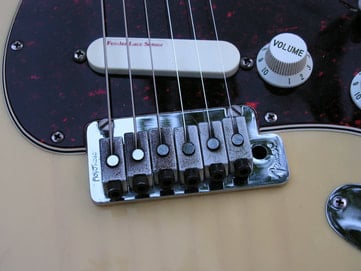
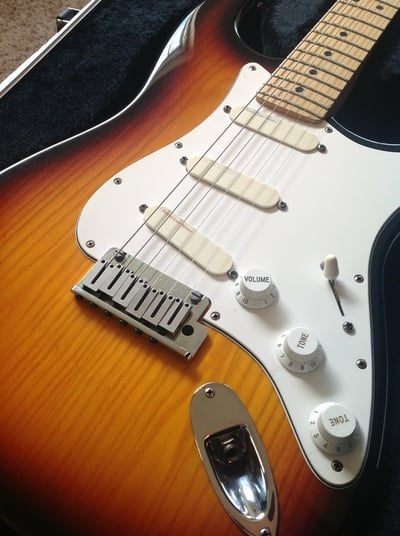
Recognizing the potential of this advancement, Dan Smith initiated discussions with Lace that culminated in an exclusive contract with Fender, signed in September 1986. Fender began using Lace-designed pickups, known as Fender Lace Sensors, on their own guitars. These pickups were originally made for the Strat Plus but were also used on the Deluxe American Standard and the Buddy Guy, Jeff Beck, and Eric Clapton signature models. The latter two guitars were the last Stratocasters equipped with Lace Sensors.
Although Fender phased out Lace Sensors in 2001 in favor of their own Fender Noiseless pickups, Lace Sensors remain respected among vintage enthusiasts and collectors.
Don Lace Sr. passed away on October 11, 1992, after which his sons, Don Jr. and Jeff Lace, assumed leadership of the company. They have continued to innovate and develop new pickup technologies, maintaining the company’s reputation for high-quality, noiseless pickups
Don and Jeff Lace
Don and Jeff Lace
Inside the Actodyne General

Lace Sensor Technology

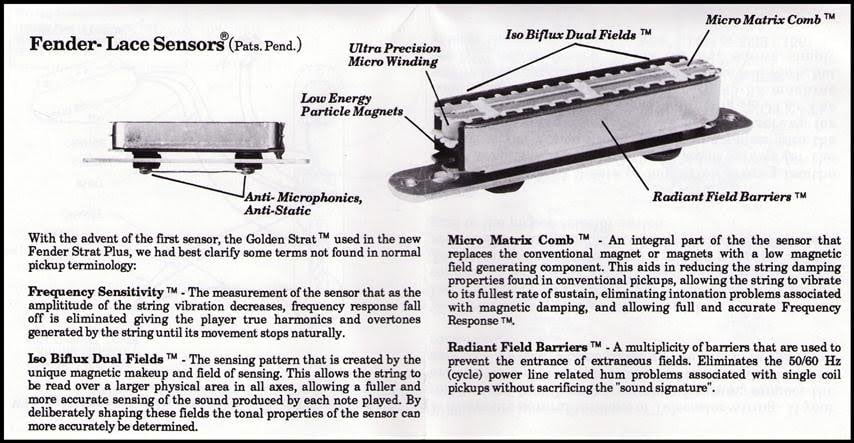
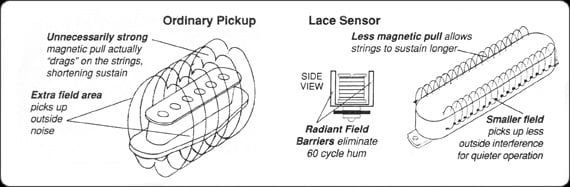
Lace Sensor pickups had a unique approach to reducing electromagnetic interference (EMI), the primary cause of 60-cycle hum in traditional single-coil pickups.
Instead of relying on traditional shielding, Don Lace Sr. used the unique Radiant Field Barrier, metal slides that surrounded both the coil and magnets, reducing the annoying 60-cycle hum. These barriers also produced a broader, yet more concentrated umbrella of a sensing field than that of standard magnetic pickups.
The Micro Matrix Combs replaced traditional bobbins, yielding a wider tonal range and better string balance than traditional pickups.
Lace Sensor
Dismantled Lace Sensor
Lace Sensors generated 36 separate magnetic “sensing” fields which, in the areas where they contacted the string, read the strings’ vibration—regular pickups only generated anywhere from 4 to 12 fields.
Compared to standard pickups, the sensors read a greater physical area of the string while picking up less outside interference. This made the signal-to-noise ratio nothing short of phenomenal for a single-coil system. Also, a wider range of harmonic content was read.
Since they operated so efficiently, Lace Sensors utilized much lower energy magnets than ordinary pickups, reducing string pull and enhancing sustain.
The sensors are precision-wound and offer more consistent output and tone compared to hand-wound pickups.
Lace Sensor explained

Lace Sensor Models

In total, four “flavors” of Fender Lace Sensor were introduced, each identified by a color-coded system:
Fender Lace Sensor Gold
GOLD
​Classic ‘50s single-coil sound with a glassy bell-like tone. Suitable for use in all positions. (Resistance: 5.8k, Peak Frequency: 3600, Inductance: 2.4 henries)
Fender Lace Sensor Silver
SILVER
Fat ‘70s single coil sound with increased output and more midrange. Suitable for use in all positions. (Resistance: 7.1k, Peak Frequency: 3000, Inductance: 3.38 henries)
Lace Sensor Blue
BLUE
Slightly increased output with a warm ‘50s P-90 fat sound. Position: neck, bridge (Resistance: 12.8k, Peak Frequency: 2100, Inductance: 6.58 henries).
Lace Sensor Red
RED
High-output tone, perfect for the bridge position when fat, punch humbucking output was required. Position: neck, mid & bridge (Resistance: 14.5k, Peak Frequency: 1850, Inductance: 8.12 henries)
It was possible to position two Lace Sensors side by side, effectively creating a type of humbucker, although their design concept was completely different.
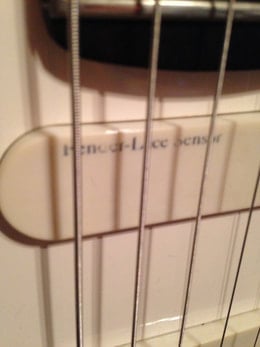
Before 1993, the top of the cover was smooth, with the “Fender Lace Sensor” logo printed directly on the surface (As shown in the picture of the Fender Lace Sensor Gold)—making the lettering prone to wearing off easily. Around late 1992, the cover was redesigned to recess the logo into an oval-shaped area, providing better protection and helping to preserve the lettering longer.
Until the end of 1992, Lace Sensor pickups had only white and orange wires; the green ground wire was added later.​
Fender Lace Sensor Dual Red
Antonio Calvosa

Contatti e Mailing List
La pubblicità su Fuzzfaced
Privacy Policy 
Tab Store
Paypal

Copyzero
© COPYRIGHT 2014-2024 FUZZFACED.NET BY ANTONIO CALVOSA - TUTTI I DIRITTI RISERVATI
​La copia, la riproduzione, la pubblicazione e la redistribuzione dei contenuti, se non autorizzate espressamente dall'autore, sono vietate in qualsiasi modo o forma. 

DICHIARAZIONE
Le parole Fender®, Telecaster®, Stratocaster® e i design delle palette sono marchi registrati di Fender Musical Instruments Corporation.

Contacts and Mailing List
Advertising on Fuzzfaced
Privacy Policy
Tab Store
PayPal

Copyzero
© COPYRIGHT 2014-2024 FUZZFACED.NET BY ANTONIO CALVOSA - ALL RIGHTS RESERVED
The copying, reproduction, publication and redistribution of the contents, unless expressly authorized by the author, are prohibited in any way or form.

DISCLOSURE
The words Fender®, Telecaster®, Stratocaster® and the associated headstock designs are registered trademarks of the Fender Musical Instruments Corporation.
  • Home
  • Home
  • Stratocaster
  • Stratocaster
  • Telecaster
  • Telecaster
  • Les Paul
  • Les Paul
  • Marshall & Celestion
  • Marshall & Celestion
  • Pedals
  • Pedali
  • my gear
  • my gear
  • Stories
  • Aneddoti
  • Blog
  • Blog