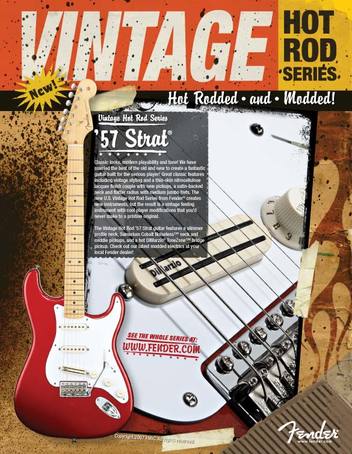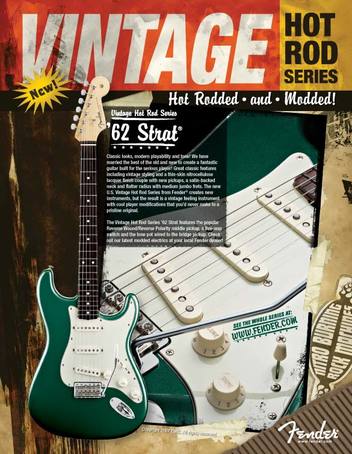
When Fender unveiled the Vintage Hot Rod line at Winter NAMM 2007, the concept was clever yet straightforward: start with the beloved American Vintage Reissue (AVRI) models and add just enough modern refinements for players who wanted classic looks with contemporary playability.
Though short-lived, the series proved influential and highlighted Fender’s willingness to experiment within its most traditional lineup. This approach was not entirely new; just a year earlier, the Mexican-made Classic Player Series had combined vintage-inspired designs with hotter pickups, updated switching, and revised hardware. Building on that concept, the Hot Rods extended the philosophy into the premium U.S. range, offering nitrocellulose finishes, upgraded components, and subtler tweaks. At their debut, trade writers summed them up neatly as “vintage feel with modern features.”
Continuing this balanced approach, these guitars were never about radical reinvention. Instead, Fender carefully blended period-correct details—such as nitro finishes, vintage-style hardware, and classic outlines—with features that enhanced playability, including flatter fretboards, medium-jumbo frets, and hotter or noiseless pickups. The result was a lineup that looked straight out of the ’50s and ’60s, but played like instruments built for a modern stage.
The first two Vintage Hot Rod Stratocasters were:
Though short-lived, the series proved influential and highlighted Fender’s willingness to experiment within its most traditional lineup. This approach was not entirely new; just a year earlier, the Mexican-made Classic Player Series had combined vintage-inspired designs with hotter pickups, updated switching, and revised hardware. Building on that concept, the Hot Rods extended the philosophy into the premium U.S. range, offering nitrocellulose finishes, upgraded components, and subtler tweaks. At their debut, trade writers summed them up neatly as “vintage feel with modern features.”
Continuing this balanced approach, these guitars were never about radical reinvention. Instead, Fender carefully blended period-correct details—such as nitro finishes, vintage-style hardware, and classic outlines—with features that enhanced playability, including flatter fretboards, medium-jumbo frets, and hotter or noiseless pickups. The result was a lineup that looked straight out of the ’50s and ’60s, but played like instruments built for a modern stage.
The first two Vintage Hot Rod Stratocasters were:
- Vintage Hot Rod '57 Stratocaster
Featuring a “V”-shaped one-piece maple neck with a 9.5" fingerboard radius, medium-jumbo frets, Samarium Cobalt Noiseless pickups in the neck and middle positions, and a DiMarzio Tone Zone S at the bridge. It delivered classic sparkle on top with extra muscle where it mattered. - Vintage Hot Rod '62 Stratocaster
Built with a thick “C”-shaped maple neck and rosewood fingerboard. It featured three American Vintage single-coil pickups, including a reverse-wound, reverse-polarity middle pickup for hum cancellation in positions 2 and 4.
By 2013, Fender gave the Vintage Hot Rod concept a significant refresh. This update reflected their aim to refine the idea into something sleeker, broader, and closer to what modern players were asking for.
Key upgrades included:
The new lineup introduced two dedicated Stratocaster models:
Both models also featured a distinctive neck plate engraved with two checkered flags. The serial number began with “HR.” Earlier Hot Rods had used a “V” prefix, making the change a quick way to identify the generation.
The tagline in Fender’s own press release was “the best of old and new,” and it summed things up neatly.
Despite the positive reception, the series didn’t last. By September 2014, Fender officially discontinued the Vintage Hot Rod Series. Dealers cleared stock quickly. The line quietly disappeared, with no direct replacement. In hindsight, they were transitional models. They bridged the gap between the American Vintage reissues of the 2000s and the later American Original series.
Key upgrades included:
- Compound-radius fretboards — comfortable for chords down low, slick and bend-friendly up high.
- Slimmer neck profiles for faster playability.
- S-1 Switching, which added the bridge pickup into positions 3, 4, and 5 for expanded tonal options.
- A modern 2-Point Synchronized Tremolo for smoother vibrato action.
The new lineup introduced two dedicated Stratocaster models:
- Vintage Hot Rod '50s Stratocaster
Equipped with a Texas Special at the bridge and two American Vintage ’56 single-coils in the neck and middle. - Vintage Hot Rod '60s Stratocaster
A mix-and-match pickup set: American Vintage ’56 at the bridge, ’65 in the middle, and ’59 at the neck.
Both models also featured a distinctive neck plate engraved with two checkered flags. The serial number began with “HR.” Earlier Hot Rods had used a “V” prefix, making the change a quick way to identify the generation.
The tagline in Fender’s own press release was “the best of old and new,” and it summed things up neatly.
Despite the positive reception, the series didn’t last. By September 2014, Fender officially discontinued the Vintage Hot Rod Series. Dealers cleared stock quickly. The line quietly disappeared, with no direct replacement. In hindsight, they were transitional models. They bridged the gap between the American Vintage reissues of the 2000s and the later American Original series.
Antonio Calvosa